

PASTA framework examples for cloud-native application security help security teams move from abstract risk discussions to structured, evidence-based threat models that match how modern applications actually deploy. If your organization runs workloads across Kubernetes clusters, managed container services, and serverless functions, you already know that traditional perimeter-focused threat models miss critical attack surfaces. The Process for Attack Simulation and Threat Analysis (PASTA) methodology gives you a seven-stage, risk-centric process designed to align business objectives with technical threats. This article walks through each PASTA stage adapted specifically for cloud-native architectures, provides a reusable threat-scoring template, and covers the pitfalls that derail cloud security threat modeling efforts. You will leave with a practical playbook your team can apply to the next sprint.
What Is the PASTA Framework?
PASTA is a seven-stage threat modeling methodology that starts with business objectives and works down through technical architecture, threat enumeration, vulnerability analysis, and attack simulation before arriving at risk-ranked countermeasures. Unlike asset-only or attacker-only models, PASTA forces you to tie every identified threat back to a business impact, which makes prioritization conversations with leadership far more productive.
In practice, this means you are not just listing threats in a spreadsheet — you are mapping each threat to a revenue line, a compliance obligation, or a customer-trust metric so the business understands why a specific container misconfiguration matters more than a theoretical cryptographic weakness.
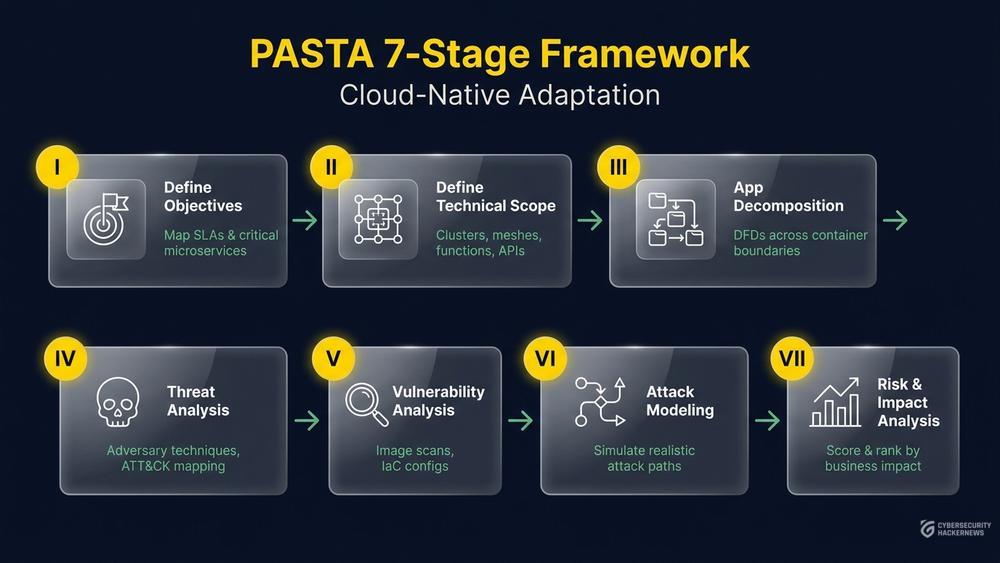
The seven stages are:
| Stage | Name | Cloud-Native Focus |
|---|---|---|
| I | Define Objectives | Map business-critical microservices and SLAs |
| II | Define Technical Scope | Enumerate clusters, service meshes, serverless functions, API gateways |
| III | Application Decomposition | Diagram data flows across container boundaries and cloud provider APIs |
| IV | Threat Analysis | Identify adversary techniques relevant to container and serverless runtimes |
| V | Vulnerability Analysis | Scan images, IaC templates, runtime configs |
| VI | Attack Modeling | Simulate realistic attack paths through the decomposed architecture |
| VII | Risk & Impact Analysis | Score and rank findings by business impact, feed into backlog |
Why It Matters for Security Teams
Cloud-native architectures fragment the attack surface across orchestrators, container images, service meshes, cloud IAM policies, and ephemeral functions. NIST SP 800-190 identifies container image vulnerabilities, orchestrator misconfigurations, and host OS weaknesses as top concerns for containerized environments [1]. NIST SP 800-204 further describes how microservices introduce trust boundaries at every service-to-service call [2]. PASTA's decomposition stages (II and III) are built to capture exactly this kind of distributed complexity, making it a natural fit for cloud-native environments.
How to Apply PASTA to Cloud-Native Applications Step by Step
Prerequisites and Setup
Before starting, gather your cloud provider architecture diagrams, Infrastructure-as-Code (IaC) repositories, container image registries, and API gateway configurations. You need a cross-functional team: at minimum one application developer, one platform/infrastructure engineer, one security engineer, and a product owner who can validate business impact assumptions.
Stage I — Define Business Objectives
Identify the business services your cloud-native application supports and the compliance obligations that apply. For an e-commerce platform running on Kubernetes, your objectives might include continuous checkout availability (revenue), PCI DSS cardholder data protection [3], and GDPR breach-notification readiness [4]. Each objective becomes a lens through which you evaluate threats later.
Stage II — Define Technical Scope
Enumerate every component: Kubernetes namespaces, node pools, ingress controllers, service mesh sidecars, serverless functions, managed databases, object storage buckets, and third-party SaaS integrations. Document the cloud provider's shared responsibility boundary — you own workload configuration and identity policies; the provider owns the hypervisor and physical infrastructure.
In practice, this means listing not just "our API" but the specific API gateway product, its authentication method, the network policy governing pod-to-pod traffic, and the IAM roles assumed by each serverless function.
Stage III — Application Decomposition
Draw data-flow diagrams (DFDs) that cross container and function boundaries. For microservices threat identification, trace a single user request from the edge load balancer through the API gateway, into the service mesh, across two or three microservices, into a database, and back. Mark every trust boundary: public internet to ingress, ingress to mesh, mesh sidecar to application container, application to managed cloud service. Each boundary is a potential point of policy enforcement failure.
Stage IV — Threat Analysis
Map adversary techniques to your decomposed architecture. MITRE ATT&CK's Containers matrix documents techniques such as T1610 Deploy Container (deploying a malicious container within the cluster) and T1611 Escape to Host (breaking out of a container to access the underlying node) [5]. For serverless security risks, consider event-injection attacks where a crafted payload in a cloud event source (S3 notification, message queue) triggers unintended function behavior, and over-permissioned execution roles that allow lateral movement across cloud services.
Build a threat library table:
| Threat | ATT&CK Technique | Affected Component | Business Objective at Risk |
|---|---|---|---|
| Malicious image deployed to cluster | T1610 Deploy Container | Kubernetes namespace | Checkout availability, data protection |
| Container escape to host | T1611 Escape to Host | Worker node | All objectives (full host compromise) |
| Excessive function IAM permissions | Privilege escalation via cloud API | Serverless execution role | Data protection, compliance |
| Service-to-service auth bypass | Lateral movement within mesh | Service mesh mTLS config | Data integrity, checkout availability |
| Injection via event source | Execution via crafted event payload | Serverless trigger (queue, bucket) | Data protection |
Stage V — Vulnerability Analysis
Scan container images in your registry for known vulnerabilities and evaluate findings against the CISA Known Exploited Vulnerabilities (KEV) catalog for evidence of active exploitation [6]. Review IaC templates for misconfigurations: overly permissive network policies, secrets stored in environment variables, missing pod security admission controls. This is where container security analysis becomes concrete — you are correlating the threats from Stage IV with actual weaknesses found in your environment.
Stage VI — Attack Modeling
Select the highest-impact threat paths from Stages IV and V and simulate them. For the "container escape to host" scenario, walk through: attacker gains code execution inside a pod (initial access via vulnerable application dependency), escalates to root within the container (misconfigured security context), exploits a kernel vulnerability to escape to the node, then pivots to the Kubernetes API using the node's service account token. Document each step's preconditions and the detection or prevention control that should stop it.
Stage VII — Risk and Impact Analysis
Score each attack path using the template in the next section. Feed scored findings into your engineering backlog with clear acceptance criteria: "Enforce restricted pod security standard across all production namespaces" is actionable; "improve container security" is not.
Template: PASTA Cloud-Native Threat Scoring Matrix
Use this matrix to score each identified threat path. Copy it into your team's wiki or ticketing system and fill one row per threat path from Stage VI. Adjust the weight column to reflect your organization's risk appetite — a fintech handling payment flows may weight Data Sensitivity higher than a media streaming service.
| Factor | Weight (adjust to org) | Score 1 (Low) | Score 3 (Medium) | Score 5 (High) | Your Score |
|---|---|---|---|---|---|
| Business Impact | 0.30 | No revenue/compliance impact | Degraded service, minor regulatory exposure | Revenue loss, breach notification, regulatory fine | ___ |
| Exploitability | 0.25 | Requires physical access or insider | Requires authenticated access plus chained vulns | Unauthenticated, remotely exploitable, public PoC | ___ |
| Data Sensitivity | 0.20 | Public data only | Internal operational data | PII, cardholder data, credentials | ___ |
| Blast Radius | 0.15 | Single container/function | Single namespace or service group | Cross-cluster, cross-account, or full environment | ___ |
| Detection Maturity | 0.10 | Mature detection, tested runbook | Partial alerting, untested response | No detection, no runbook | ___ |
| Weighted Total | ___ |
How to adapt it: Multiply each factor's score by its weight, then sum. Paths scoring above your organization's agreed threshold (many teams start at 3.5) go directly into the current sprint backlog. Paths between 2.5 and 3.5 enter the next planning cycle. Paths below 2.5 are documented and reviewed quarterly. The threshold itself is a risk-acceptance decision your security and product leadership make together.
Best Practices
Integrate PASTA into your CI/CD pipeline, not around it. Run Stage V image scanning and IaC policy checks as pipeline gates. Block deployments that contain any vulnerability listed in the KEV catalog or any critical finding on an internet-facing service — remaining findings are triaged and accepted by the risk owner per your organization's threshold.
Revisit threat models on architecture changes, not on a calendar. A new microservice, a migration from containers to serverless, or a new third-party API integration should each trigger a lightweight PASTA iteration focused on Stages II–IV.
Use service mesh telemetry for Stage VI validation. If you run a service mesh, its access logs and distributed traces give you empirical data on actual service-to-service communication patterns. Compare these against your Stage III DFDs to find undocumented data flows — they often represent shadow dependencies that your threat model missed.
Map findings to NIST CSF 2.0 categories for executive reporting. Threat model outputs map naturally to ID.RA (Risk Assessment) for identification and PR.PS (Platform Security) for remediation tracking [7]. This translation helps leadership see threat modeling as part of the governance lifecycle rather than a standalone engineering exercise.
Tools Comparison
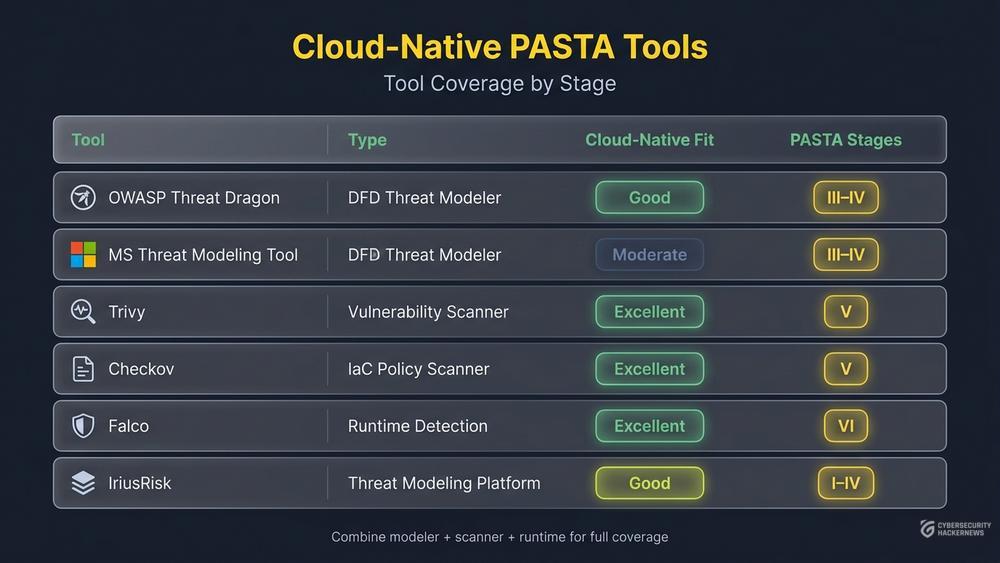
| Tool | Type | Cloud-Native Fit | Strengths | Limitations |
|---|---|---|---|---|
| OWASP Threat Dragon | DFD-based threat modeler | Good for Stage III decomposition | Open-source, visual DFDs, STRIDE integration | No built-in container/K8s awareness |
| Microsoft Threat Modeling Tool | DFD-based threat modeler | Moderate — Azure-focused templates | Mature, template-driven, auto-generates threats | Windows-only, limited multi-cloud support |
| Trivy | Vulnerability scanner | Excellent — scans images, IaC, K8s configs | Fast, covers Stages V dependencies, open-source | Scanner only; no threat modeling workflow |
| Checkov | IaC policy scanner | Excellent — Terraform, Helm, CloudFormation | Catches misconfigurations in Stage V, CI/CD integration | Does not model attack paths |
| Falco | Runtime threat detection | Excellent — kernel-level container monitoring | Stage VI validation via runtime rule violations | Requires tuning to reduce noise |
| IriusRisk | Threat modeling platform | Good — supports custom component libraries | Automates threat library, integrates with Jira | Commercial, learning curve for custom cloud components |
In practice, this means most teams combine a threat modeling tool (Threat Dragon or IriusRisk for Stages I–IV) with scanning tools (Trivy, Checkov for Stage V) and runtime detection (Falco for Stage VI validation) rather than relying on a single product.
Real-World Example (Illustrative Scenario)
⚠️ Disclaimer: The following scenario is an illustrative example based on typical industry patterns. The specific metrics are hypothetical estimates designed to demonstrate realistic outcomes, not measured data from a documented project. They should not be cited as factual benchmarks.
Context: A mid-sized fintech company runs a payment processing platform on managed Kubernetes with several serverless functions handling event-driven reconciliation. The security team of four engineers had no formal threat modeling process and relied on ad-hoc vulnerability scanning.
Challenge: After a near-miss incident where an overly permissioned serverless execution role could have allowed cross-account access to production databases, the CISO mandated a structured threat modeling approach. The team needed a method that connected technical findings to business risk for board-level reporting.
Solution: The team adopted PASTA, customized for their cloud-native stack. In Stage II, they cataloged all Kubernetes namespaces, serverless functions, and managed database instances. Stage III produced data-flow diagrams tracing payment transactions across service boundaries. Stage IV used MITRE ATT&CK's Containers matrix to build a threat library. Stage V integrated Trivy and Checkov into CI/CD pipelines. Stage VI simulated three high-priority attack paths, including the serverless privilege escalation that triggered the initiative. Stage VII used the scoring matrix above to prioritize remediation into two-week sprints.
Results (illustrative estimates):
- Identified and remediated critical serverless IAM over-permissions across the environment within two sprint cycles (illustrative)
- Reduced backlog of unranked vulnerability findings by approximately 70% through risk-based prioritization (illustrative)
- Decreased mean time from vulnerability discovery to remediation decision from weeks to days for high-scoring threats (illustrative)
- Achieved structured board-level risk reporting, replacing ad-hoc spreadsheets with PASTA-scored threat summaries (illustrative)
Key Takeaways: PASTA's seven-stage structure gave the team a repeatable process that connected container misconfigurations and serverless security risks directly to business impact. The scoring matrix made prioritization transparent and defensible. The biggest friction point was Stage III — diagramming data flows across dozens of microservices took longer than expected, and the team learned to scope initial iterations to a single critical transaction path rather than modeling the entire platform at once.
Common Pitfalls
Modeling the entire platform in one pass. Teams that try to decompose every microservice, function, and data store in Stage III stall and abandon the effort. Start with your highest-value transaction path — typically the one handling money or sensitive data — and expand iteratively.
Skipping Stage I business objectives. Without explicit business objectives, Stage VII scoring degenerates into subjective arguments. A container escape in a development sandbox and a container escape in a production payment namespace look identical technically but differ enormously in business impact. PASTA's value comes from that distinction.
Treating PASTA as a one-time compliance exercise. A threat model that is not updated when architecture changes becomes a misleading artifact. Tie threat model reviews to architecture decision records (ADRs) so that every significant infrastructure change triggers at minimum a Stage II–IV refresh.
Confusing vulnerability scanning with threat modeling. Running Trivy on your container images covers part of Stage V, but it tells you nothing about attack paths (Stage VI) or business impact (Stage VII). Scanning finds weaknesses; PASTA connects them into exploitable scenarios ranked by organizational risk.
Ignoring serverless and event-driven attack surfaces. Teams comfortable with container security analysis often overlook serverless functions because they have no persistent infrastructure to scan. But overly broad IAM execution roles, injection through event sources (queue messages, storage events), and cold-start timing side-channels are all real attack surfaces that belong in Stage IV.
Over-relying on CVSS base scores for prioritization. CVSS measures the technical severity of a vulnerability, not organizational risk [8]. A CVSS 9.8 vulnerability in an isolated, non-internet-facing internal tool may pose less organizational risk than a CVSS 6.5 vulnerability in your payment API's authentication flow. PASTA's Stage VII scoring adds the business context that CVSS alone cannot provide.
Next Steps
Start with one critical transaction path in your cloud-native application — the flow that handles your most sensitive data or drives your primary revenue. Assemble a small cross-functional group (developer, platform engineer, security engineer, product owner) and walk through PASTA Stages I–III in a two-hour session using the structure outlined above. Copy the scoring matrix template into your team wiki and use it to rank the first three threat paths your group identifies. Schedule a Stage IV–VII follow-up within the same sprint. After completing your first iteration, review NIST SP 800-190 [1] and NIST SP 800-204 [2] for additional container and microservices security controls to incorporate into your threat library. Expand to the next transaction path in the following sprint.
Sources
[1] M. Souppaya, J. Morello, and K. Scarfone, "Application Container Security Guide," NIST Special Publication 800-190, National Institute of Standards and Technology, 2017. [Online]. Available: https://csrc.nist.gov/pubs/sp/800/190/final
[2] R. Chandramouli, "Security Strategies for Microservices-based Application Systems," NIST Special Publication 800-204, National Institute of Standards and Technology, 2019. [Online]. Available: https://csrc.nist.gov/pubs/sp/800/204/final
[3] PCI Security Standards Council, "Payment Card Industry Data Security Standard v4.0.1," 2024. [Online]. Available: https://www.pcisecuritystandards.org/standards/pci-dss/
[4] European Parliament and Council of the European Union, "Regulation (EU) 2016/679 (General Data Protection Regulation)," 2016. [Online]. Available: https://eur-lex.europa.eu/eli/reg/2016/679/oj
[5] MITRE, "MITRE ATT&CK," The MITRE Corporation. [Online]. Available: https://attack.mitre.org/
[6] CISA, "Known Exploited Vulnerabilities Catalog," Cybersecurity and Infrastructure Security Agency. [Online]. Available: https://www.cisa.gov/known-exploited-vulnerabilities-catalog
[7] NIST, "The NIST Cybersecurity Framework (CSF) 2.0," NIST Cybersecurity White Paper 29, National Institute of Standards and Technology, 2024. [Online]. Available: https://csrc.nist.gov/pubs/cswp/29/the-nist-cybersecurity-framework-csf-20/final
[8] FIRST, "CVSS v4.0 Specification Document," Forum of Incident Response and Security Teams, 2023. [Online]. Available: https://www.first.org/cvss/v4.0/specification-document