

When two tenants share an Azure subscription and one gets compromised, the blast radius can extend far beyond what most teams anticipate. Designing Azure security architecture patterns for multi-tenant environments is one of the hardest problems in cloud security — and getting the isolation model wrong is among the most consequential decisions you can make. This article gives you a practical playbook for multi-tenant security design: how to structure your landing zones, which isolation strategies to pick, and how to detect cross-tenant misconfigurations before an attacker exploits them. Whether you build SaaS platforms or manage internal business units in a shared Azure estate, you will walk away with a decision matrix, a deployable Sigma rule, and a checklist you can adapt to your own environment.
Table of Contents
- What Is Multi-Tenant Security in Azure?
- How to Design Isolation Strategies Step by Step
- Best Practices
- Tools Comparison
- Real-World Example (Illustrative Scenario)
- Common Pitfalls in Multi-Tenant Security Design
- FAQ
- Next Steps
- Sources
What Is Multi-Tenant Security in Azure?
A multi-tenant environment is any Azure estate where distinct organizational units, customers, or business lines share infrastructure while requiring logical or physical separation of data, identity, and network paths. The core challenge is preventing one tenant's actions — or one tenant's compromise — from affecting another.
In practice, this means you are balancing cost efficiency (shared resources) against blast-radius containment (strong isolation). Every additional sharing point is a potential lateral-movement path for an adversary.
Why It Matters for Security Teams
NIST CSF 2.0 identifies Asset Management (ID.AM) and Platform Security (PR.PS) as core categories for understanding what you protect and how you harden it [1]. In a multi-tenant model, a misconfigured Network Security Group (NSG) or an overly broad Azure Role-Based Access Control (RBAC) assignment can expose tenant B's data to tenant A's administrators.
ISO/IEC 27001:2022 requires organizations to determine the boundaries and applicability of the information security management system, including interfaces and dependencies between activities performed by the organization and those performed by other organizations [2]. In multi-tenant Azure, those boundaries run through management groups, subscriptions, and Microsoft Entra ID tenant objects.
How to Design Isolation Strategies Step by Step
Isolation strategies in Azure range from soft logical boundaries to hard infrastructure separation. The right choice depends on your regulatory obligations, data sensitivity, and operational capacity.
Prerequisites
Before you design, inventory these items:
| Item | Why It Matters |
|---|---|
| Tenant data classification | Determines minimum isolation level |
| Regulatory scope (GDPR, NIS2, PCI DSS) | Dictates residency and access controls |
| Number of tenants | Drives subscription topology cost |
| Shared-service dependencies | Identifies cross-tenant data flows |
| Identity provider model | Single vs. separate Entra ID tenants |
Step 1: Choose Your Isolation Boundary
Azure provides three primary isolation boundaries, each with different security properties:
| Boundary | Isolation Strength | Cost | Typical Use Case |
|---|---|---|---|
| Resource Group | Low — shared subscription, shared IAM | Lowest | Internal dev/test environments |
| Subscription | Medium — separate IAM boundary, separate billing | Moderate | Business-unit separation, regulated workloads |
| Entra ID Tenant | High — separate identity boundary, separate directory | Highest | External-customer SaaS, M&A isolation |
NIST SP 800-53 Rev. 5 control family AC (Access Control) defines controls for separation of duties and least privilege that map directly to how you assign RBAC roles at each boundary [3].
In practice, this means if you choose resource-group isolation, a single compromised subscription-level Contributor role can traverse all tenant resource groups. Subscription-level isolation limits that blast radius.
Step 2: Structure Your Azure Landing Zone Security
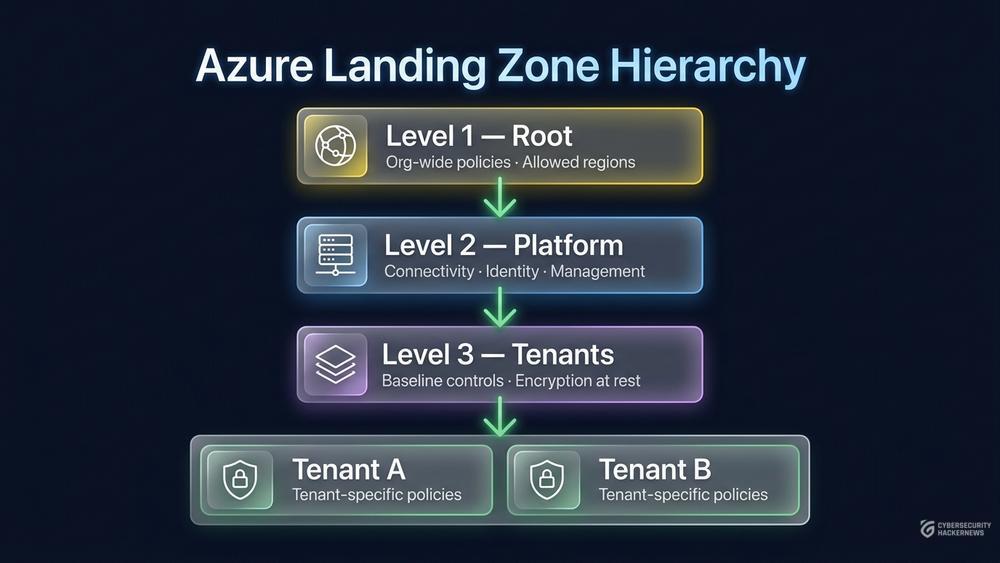
Azure landing zone security starts with management group hierarchy. A well-designed hierarchy enforces policy inheritance so that tenant subscriptions receive baseline controls without manual configuration.
A recommended hierarchy for multi-tenant environments:
| Level | Management Group | Purpose |
|---|---|---|
| 1 | Root | Organization-wide policies (allowed regions, diagnostic settings) |
| 2 | Platform | Shared services: connectivity hub, identity, management |
| 3 | Tenants | Parent group for all tenant subscriptions |
| 4 | Tenant-A, Tenant-B… | Individual tenant subscriptions with tenant-specific policies |
CIS Critical Security Controls v8.1, specifically Control 3 (Data Protection) and Control 6 (Access Control Management), provide safeguards for classifying data and enforcing access rules that align with this hierarchy [4].
In practice, this means you assign Azure Policy at the "Tenants" management group level for baseline controls (such as requiring encryption at rest), then override at the individual tenant level only when a specific tenant has a stricter requirement.
Step 3: Enforce Network Isolation
Network isolation prevents tenant workloads from communicating with each other unless explicitly permitted. Key controls include:
- Separate virtual networks (VNets) per tenant with no peering between tenant VNets
- Hub-and-spoke topology where the hub provides shared egress/ingress and each spoke is a tenant VNet
- NSG rules scoped to each tenant's subnet, denying inter-tenant traffic by default
- Private Endpoints for PaaS services, ensuring data-plane traffic stays on the Microsoft backbone
NIST SP 800-53 Rev. 5 control SC-7 (Boundary Protection) requires organizations to monitor and control communications at external and key internal boundaries [3].
Step 4: Implement Identity Isolation
Identity is the control plane in Azure. For multi-tenant security design, you have two principal models:
| Model | Mechanism | Tenant Data Exposure Risk |
|---|---|---|
| Single Entra ID, RBAC separation | Custom roles scoped to tenant subscriptions | Moderate — directory enumeration possible |
| Separate Entra ID tenants | Azure Lighthouse or B2B for cross-tenant management | Lower — under proper configuration, tenant B's users lack directory visibility into tenant A |
NIST SP 800-207 defines zero trust architecture as requiring that "no implicit trust is granted to assets or user accounts based solely on their physical or network location" [5]. In practice, this means each tenant's service principals and managed identities should be scoped to their own subscription and should have no permissions in another tenant's scope.
Decision Matrix: Selecting Your Isolation Model
Use the following matrix to select the right isolation model for each tenant. Score each criterion from 1 (low) to 3 (high), then sum the row. This is a starting template — adapt the thresholds and criteria to your organization's risk appetite and regulatory posture.
| Criterion | Weight | Score 1 (Low) | Score 2 (Medium) | Score 3 (High) |
|---|---|---|---|---|
| Data sensitivity | 3× | Internal-only, non-regulated | Regulated but shared-industry | PII/financial, cross-border |
| Regulatory mandate | 2× | No specific isolation clause | Sector guidance recommends separation | Explicit tenant-isolation requirement |
| Tenant trust level | 2× | Internal business unit | Contractual partner | External customer, competitor |
| Blast-radius tolerance | 3× | Shared incident acceptable | Incident contained within hours | Zero cross-tenant impact required |
How to adapt this template: Replace the criteria with your organization's own risk factors. Add rows for operational capacity (can you manage N separate Entra ID tenants?) and cost constraints. Set your own threshold: for example, a weighted score above 25 may call for separate Entra ID tenants, 15–25 for subscription-level isolation, and below 15 for resource-group separation. Document the rationale and have your risk owner sign off.
Scoring guide: Multiply each score by its weight. A weighted total above 25 typically points toward Entra ID tenant separation; 15–25 toward subscription isolation; below 15 toward resource-group separation.
Best Practices
- Apply Azure Policy at the management group level — enforce tagging, allowed resource types, and diagnostic-settings requirements so tenant subscriptions inherit guardrails automatically.
- Use Privileged Identity Management (PIM) — require just-in-time activation for any role that crosses tenant boundaries; set maximum activation duration to the minimum operationally viable window.
- Separate Key Vaults per tenant — cryptographic material for tenant A should not be accessible to tenant B's managed identities or service principals.
- Enable Microsoft Defender for Cloud on every subscription — aggregate findings into a central Log Analytics workspace while preserving tenant-scoped visibility through workspace-level RBAC.
- Automate drift detection — use Azure Policy compliance dashboards and scheduled exports to detect when a subscription's configuration deviates from your baseline.
- Log everything to a centralized, tenant-tagged SIEM — MITRE ATT&CK technique T1078 (Valid Accounts) is one of the most common initial-access methods in cloud environments [6]. Cross-tenant log correlation helps detect credential abuse across boundaries.
ISO/IEC 27001:2022 Annex A control 5.15 (Access control) requires that rules to control physical and logical access to information and other associated assets be established and implemented based on business and information security requirements [2].
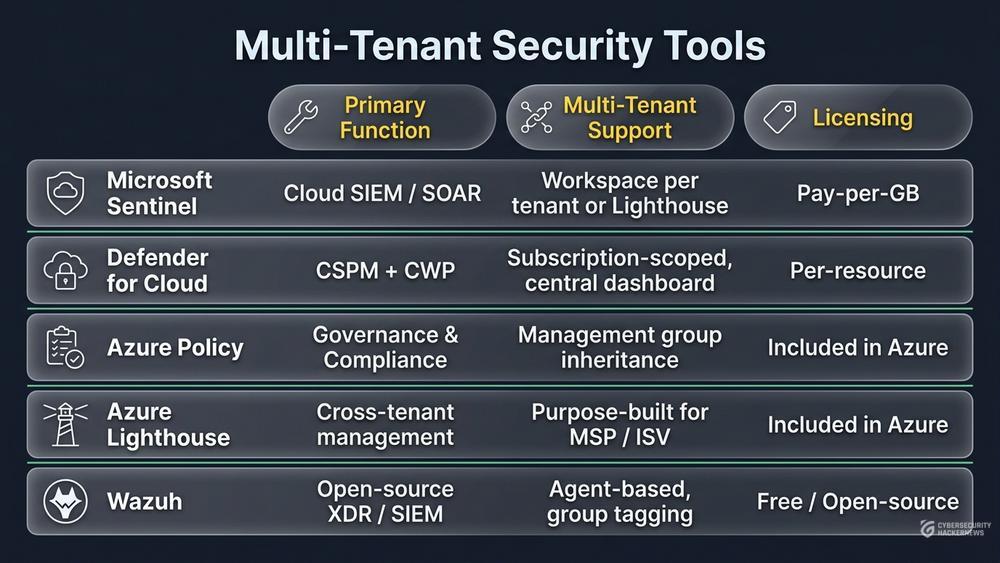
Tools Comparison
| Tool | Primary Function | Multi-Tenant Support | Licensing |
|---|---|---|---|
| Microsoft Sentinel | Cloud-native SIEM/SOAR | Workspace per tenant or Lighthouse-based cross-tenant | Pay-per-GB ingested |
| Microsoft Defender for Cloud | CSPM + CWP | Subscription-scoped findings, central dashboard | Per-resource pricing |
| Azure Policy | Governance and compliance | Management-group inheritance | Included in Azure |
| Azure Lighthouse | Cross-tenant delegated management | Purpose-built for multi-tenant MSP/ISV scenarios | Included in Azure |
| Wazuh | Open-source XDR and SIEM | Agent-based, multi-tenant via group tagging | Free / open-source |
Real-World Example (Illustrative Scenario)
⚠️ Disclaimer: The following scenario is an illustrative example based on typical industry patterns. The specific metrics are hypothetical estimates designed to demonstrate realistic outcomes, not measured data from a documented project. They should not be cited as factual benchmarks.
Context: A mid-sized European SaaS provider hosts twelve enterprise customers on a shared Azure estate. The security team consists of four engineers. All tenants share a single Entra ID directory with RBAC separation at the subscription level.
Challenge: During a routine access review, the team discovers that a service principal used by Tenant C's deployment pipeline holds Contributor rights at the management-group level, granting it write access to all twelve tenant subscriptions. The misconfiguration has existed for several months. The team also identifies that NSG rules permit east-west traffic between three tenant VNets that should be isolated.
Solution: The team restructures the environment using the approach described in this article:
- Moves to per-tenant subscriptions under a dedicated "Tenants" management group
- Deploys Azure Policy to deny VNet peering between tenant spokes
- Scopes all service principals to individual subscription RBAC
- Deploys a Sigma rule (see the detection section below) to alert on cross-tenant role assignments
- Enables PIM for all standing administrative roles
Results (illustrative estimates):
- Cross-tenant RBAC misconfigurations reduced by approximately 75% within two months (illustrative)
- Mean time to detect overly broad role assignments dropped from several days to roughly 45 minutes (illustrative)
- Inter-tenant network exposure paths eliminated from three to zero (illustrative)
- Policy-compliance score for tenant subscriptions reached approximately 92% (illustrative)
Key Takeaways: Start by auditing existing cross-tenant permissions before restructuring the management group hierarchy. Automated policy enforcement catches drift faster than periodic manual reviews.
Sigma Rule: Detect Cross-Tenant Role Assignment
The following Sigma rule detects when an Azure RBAC role is assigned at a scope broader than a single subscription — a common indicator of misconfiguration or privilege escalation in multi-tenant environments. It queries Azure Activity Logs, which you can ingest into Microsoft Sentinel, Splunk, or Elastic Security. A Sigma rule is a vendor-neutral detection format: you write the logic once, then convert it to your SIEM's native query language using a Sigma converter.
title: Azure Cross-Tenant Broad Role Assignment Detected
id: 7c3e91a2-4f8b-4d2e-b6a1-9e5f0c8d7b34
status: experimental
description: Detects Azure RBAC role assignments at management group scope, which may indicate cross-tenant privilege escalation or misconfiguration in multi-tenant environments.
logsource:
    product: azure
    service: activitylogs
detection:
    selection:
        operationName: Microsoft.Authorization/roleAssignments/write
        status: Succeeded
    filter_scope:
        properties.scope|contains: /providers/Microsoft.Management/managementGroups/
    condition: selection and filter_scope
falsepositives:
    - Legitimate platform-team role assignments during landing zone provisioning
    - Automated IaC pipelines with approved management-group scope
level: high
tags:
    - attack.privilege_escalation
    - attack.t1078
This rule targets MITRE ATT&CK technique T1078 (Valid Accounts) [6], which covers adversary use of legitimate credentials — including overly broad service principals — to gain access across trust boundaries.
Common Pitfalls in Multi-Tenant Security Design
Isolation strategies fail most often not from missing controls but from architectural shortcuts and operational drift. Here are common mistakes and their consequences:
| Pitfall | Consequence | Mitigation |
|---|---|---|
| Shared subscription for multiple tenants | Single compromised identity can access all tenant resources | Use per-tenant subscriptions with RBAC scoped to subscription level |
| Management-group-scoped service principals | Deployment pipeline compromise grants access to every tenant | Scope service principals to the narrowest subscription or resource group |
| Missing network segmentation | Lateral movement between tenant VNets via peered networks | Deploy hub-and-spoke with no spoke-to-spoke peering; deny by default in NSGs |
| Single Key Vault for all tenants | Compromised Key Vault exposes every tenant's secrets | Provision per-tenant Key Vaults with isolated access policies |
| No automated drift detection | Configurations degrade over time without alerting | Enforce Azure Policy at management-group level and export compliance data to your SIEM |
| Ignoring activity-log forwarding | Cross-tenant privilege escalation goes undetected for extended periods | Forward Activity Logs to a central workspace; deploy detection rules like the Sigma rule above |
NIST SP 800-53 Rev. 5 control CM-3 (Configuration Change Control) requires organizations to determine and document the types of changes to the system that are configuration-controlled [3]. In practice, this means treating RBAC assignments and network topology changes as configuration items that require change-control approval.
Next Steps
- Audit your current RBAC assignments — export role assignments across all subscriptions and flag any scoped at the management-group level that are not explicitly approved by your security team.
- Deploy the Sigma rule above in your SIEM and tune the false-positive list for your platform team's expected activities.
- Score your tenants using the decision matrix in this article and document the chosen isolation level for each tenant in your risk register.
- Review your Azure Policy assignments — verify that baseline policies (diagnostic settings, allowed regions, encryption requirements) are assigned at the management-group level, not individually per subscription.
- Schedule a quarterly cross-tenant access review in Microsoft Entra PIM, focusing on service principals and managed identities with scope beyond a single subscription.
Sources
[1] NIST, "The NIST Cybersecurity Framework (CSF) 2.0," NIST Cybersecurity White Paper (CSWP) 29, National Institute of Standards and Technology, 2024. [Online]. Available: https://csrc.nist.gov/pubs/cswp/29/the-nist-cybersecurity-framework-csf-20/final
[2] ISO/IEC, "Information security, cybersecurity and privacy protection — Information security management systems — Requirements," ISO/IEC 27001:2022, 2022. [Online]. Available: https://www.iso.org/standard/82875.html
[3] NIST, "Security and Privacy Controls for Information Systems and Organizations," NIST Special Publication 800-53 Rev. 5, National Institute of Standards and Technology, 2020. [Online]. Available: https://csrc.nist.gov/pubs/sp/800/53/r5/final
[4] Center for Internet Security, "CIS Critical Security Controls Version 8.1," 2024. [Online]. Available: https://www.cisecurity.org/controls/v8-1
[5] S. Rose, O. Borchert, S. Mitchell, and S. Connelly, "Zero Trust Architecture," NIST Special Publication 800-207, National Institute of Standards and Technology, 2020. [Online]. Available: https://csrc.nist.gov/pubs/sp/800/207/final
[6] MITRE, "T1078: Valid Accounts," MITRE ATT&CK. [Online]. Available: https://attack.mitre.org/