

Tools and Solutions for Proactive Ransomware Threat Hunting
Ransomware remains one of the most severe threats facing security teams, and waiting for alerts to fire means you are reacting after the damage begins. Adopting tools and solutions for proactive ransomware threat hunting shifts your posture from reactive to anticipatory. Instead of chasing encryption notifications, you hunt for the precursor behaviors that precede a detonation. This article gives you concrete workflows, a reusable decision matrix, a validated Sigma rule, and side-by-side tool comparisons. Whether you run a five-person Security Operations Center (SOC) or a mature threat-intelligence program, you will walk away with artifacts you can deploy in your environment this week.
Table of Contents
- What Is Proactive Ransomware Threat Hunting?
- Why It Matters for Security Teams
- How to Build a Ransomware Hunt Program Step by Step
- Decision Matrix: Hunt-Prioritisation Template
- Best Practices
- Tools Comparison
- Real-World Example (Illustrative Scenario)
- Common Pitfalls
- FAQ
- Next Steps
What Is Proactive Ransomware Threat Hunting?
Proactive ransomware threat hunting is a hypothesis-driven discipline where analysts actively search for signs of adversary presence before automated detections trigger. ENISA categorises ransomware among the prime threats in its threat landscape analysis [1]. Rather than relying on signature-based alerts alone, hunters formulate hypotheses based on threat intelligence and then test them against telemetry.
In practice, this means a hunter might ask: "Are any endpoints exhibiting Kerberoasting behavior that could precede ransomware deployment?" and then query logs to confirm or refute the hypothesis.
The MITRE ATT&CK knowledge base provides the taxonomy that underpins most hunt hypotheses, mapping adversary behaviors to tactics and techniques [2]. A typical ransomware kill chain traverses Initial Access (TA0001), Execution (TA0002), Privilege Escalation (TA0004), Lateral Movement (TA0008), and Impact (TA0040). Your hunts target the techniques within these tactics, well before the Impact stage.
Why It Matters for Security Teams
Automated detection rules cover known patterns, but ransomware operators continuously modify their tradecraft. Proactive hunting closes the gap between what your detections cover and what adversaries actually do. NIST CSF 2.0 formalises this under the Detect function, specifically DE.AE (Adverse Event Analysis), which calls for analysing anomalies and events to identify potential incidents [3]. CIS Controls v8.1 reinforce this through Control 13 (Network Monitoring and Defense), which calls for operating processes to detect, log, and respond to network anomalies [4].
Hunting also generates a feedback loop: every confirmed true positive becomes a new automated detection rule, steadily raising your baseline coverage.
How to Build a Ransomware Hunt Program Step by Step
Prerequisites and Setup
Before you run your first hunt, you need three things: telemetry, a hypothesis framework, and the right threat hunting platforms to query your data.
| Prerequisite | What You Need | Why |
|---|---|---|
| Telemetry coverage | Endpoint Detection and Response (EDR), Windows Event Logs (Sysmon), network metadata | Raw material for every hunt query |
| Hypothesis framework | MITRE ATT&CK Navigator, threat-intelligence feeds | Focuses hunts on the techniques ransomware operators favour |
| Query platform | Security Information and Event Management (SIEM), EDR console, or dedicated hunt tool | Where you test hypotheses against collected data |
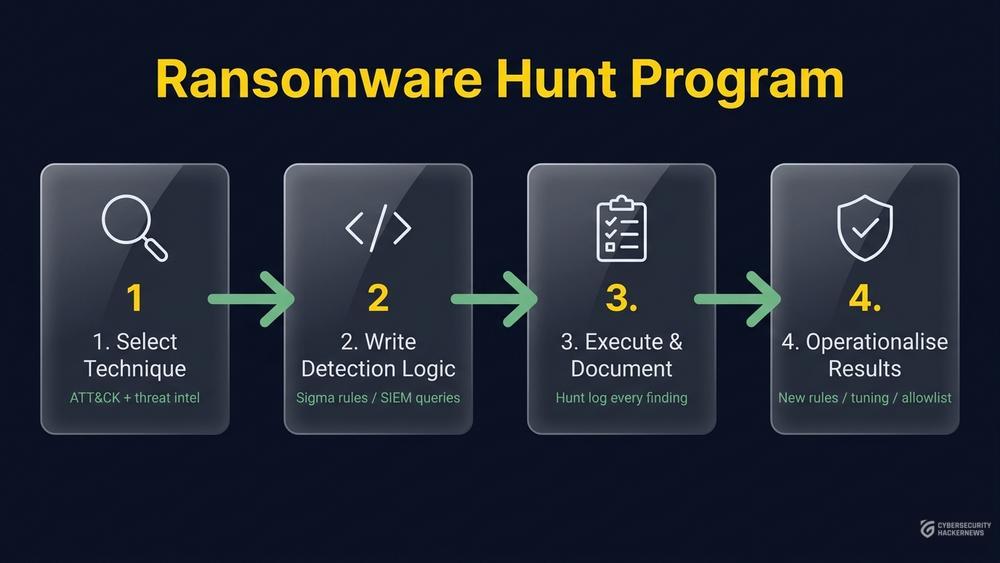
Step 1 — Select a Technique to Hunt
Start with the ATT&CK techniques most commonly observed in ransomware intrusions. CISA's joint advisory on top routinely exploited vulnerabilities highlights the initial-access vectors that feed ransomware campaigns [5]. Pair this intelligence with your own environment context: if you run a Windows-heavy estate, credential-access techniques such as OS Credential Dumping (T1003) and Kerberoasting (T1558.003) deserve priority.
Step 2 — Write or Deploy Detection Logic
A hunt hypothesis needs a testable query. Sigma is a vendor-neutral detection format that you can convert to your SIEM's native query language. Below is a validated Sigma rule for detecting suspicious Volume Shadow Copy deletion, a technique ransomware operators frequently use before encrypting files (mapped to ATT&CK T1490 — Inhibit System Recovery):
title: Suspicious Volume Shadow Copy Deletion via Vssadmin or WMIC
id: b1e3f8a2-7c4d-4e9a-a6f1-2d5c8b0e7f3a
status: stable
description: Detects deletion of Volume Shadow Copies using vssadmin.exe or wmic.exe, a precursor to ransomware encryption in many observed campaigns.
logsource:
    product: windows
    category: process_creation
detection:
    selection_vssadmin:
        Image|endswith: '\vssadmin.exe'
        CommandLine|contains|all:
            - 'delete'
            - 'shadows'
    selection_wmic:
        Image|endswith: '\wmic.exe'
        CommandLine|contains|all:
            - 'shadowcopy'
            - 'delete'
    condition: selection_vssadmin or selection_wmic
falsepositives:
    - Legitimate backup or recovery software that manages shadow copies
    - System administrators performing manual cleanup during maintenance windows
level: high
tags:
    - attack.impact
    - attack.t1490
Step 3 — Execute the Hunt and Document Findings
Run your converted query across your SIEM or EDR for a lookback window that matches your log-retention policy. Document every finding, whether true positive, benign true positive, or false positive, in a structured hunt log. This log feeds back into your detection engineering pipeline.
Step 4 — Operationalise Results
Each confirmed finding should produce one of three outputs: a new automated alert rule, an updated allowlist entry for a benign true positive, or a tuning recommendation to reduce false positives. NIST SP 800-150 emphasises that sharing cyber-threat information, including indicators discovered during hunts, strengthens collective defense [6].
Decision Matrix: Hunt-Prioritisation Template
This reusable matrix helps your team decide which ransomware-related techniques to hunt first. Score each ATT&CK technique on three dimensions, sum the scores, and sort descending. Adapt the weights to your risk appetite: an organisation with extensive remote access may weight "Exposure in your environment" higher.
| Dimension | Score 1 (Low) | Score 2 (Medium) | Score 3 (High) |
|---|---|---|---|
| Threat-intel prevalence | Technique rarely seen in ransomware reporting | Technique seen in multiple ransomware families | Technique present in campaigns targeting your sector |
| Detection coverage gap | Existing automated rules cover this technique well | Partial coverage — some variants would evade current rules | No automated detection exists for this technique |
| Exposure in your environment | Assets using this vector are isolated or decommissioned | Moderate exposure — some production systems affected | Critical assets are directly exposed to this technique |
How to adapt it: Replace the three dimensions with any risk factors relevant to your organisation, such as regulatory exposure or data-classification sensitivity. The key is consistent scoring across hunts so you can compare and sequence them objectively.
Best Practices
Effective proactive defense tools and processes share several characteristics. The following practices apply regardless of which SIEM or EDR platform you use.
- Hunt on a cadence, not ad hoc. Schedule recurring hunts aligned with your threat-intelligence update cycle — weekly for high-priority techniques, monthly for lower-priority ones.
- Layer your telemetry. Endpoint telemetry alone misses network-level indicators. Combine EDR for ransomware visibility on endpoints with network metadata (NetFlow, DNS logs, proxy logs) to catch lateral movement and command-and-control (C2) callbacks.
- Version-control your detection logic. Store Sigma rules in a Git repository so every change is reviewable, reversible, and auditable.
- Measure hunt effectiveness. Track metrics such as hunts completed per quarter, true positives found, and mean time from hypothesis to automated rule deployment.
- Align hunts with NIST CSF 2.0 categories. Map each hunt to a specific CSF 2.0 category — most ransomware hunts fall under DE.AE (Adverse Event Analysis) or DE.CM (Continuous Monitoring) [3].
Tools Comparison
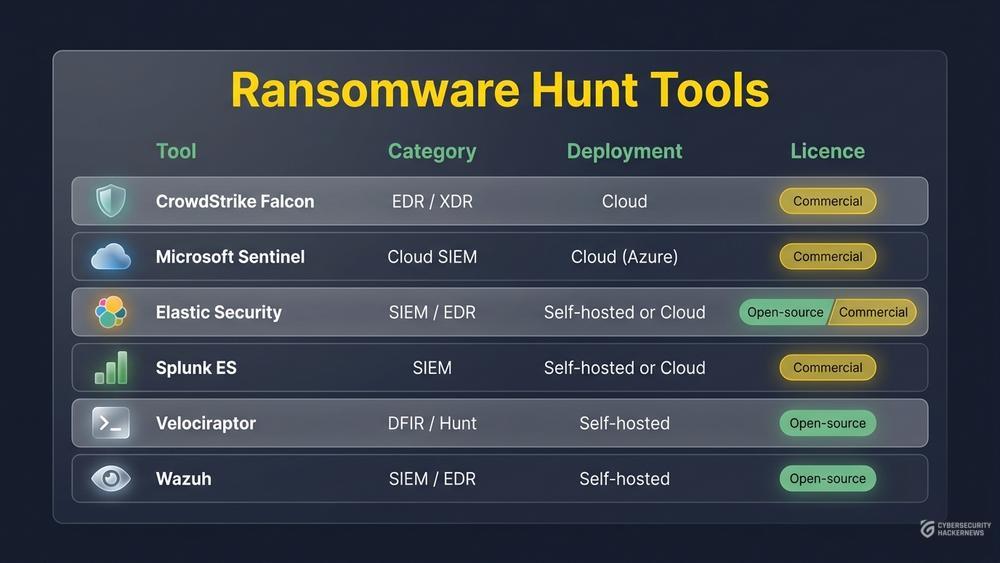
Choosing the right platform depends on your team size, budget, and existing telemetry stack. The table below compares real, widely-used tools across the categories most relevant to ransomware threat hunting.
| Tool | Category | Ransomware Hunt Strength | Deployment Model | Licence |
|---|---|---|---|---|
| CrowdStrike Falcon | EDR / XDR | Real-time endpoint telemetry, pre-built hunt queries, threat-intelligence integration | Cloud | Commercial |
| Microsoft Sentinel | Cloud SIEM | Native ATT&CK mapping, Sigma-rule import, broad log-source ecosystem | Cloud (Azure) | Commercial (consumption-based) |
| Elastic Security | SIEM / EDR | Open detection rules, flexible query language (ES | QL, KQL), community Sigma integration | Self-hosted or Cloud |
| Splunk Enterprise Security | SIEM | Mature SPL query language, extensive app marketplace, strong for SIEM ransomware detection use cases | Self-hosted or Cloud | Commercial |
| Velociraptor | DFIR / Hunt | Agentless or agent-based live-response hunts using VQL (Velociraptor Query Language), free and open-source | Self-hosted | Open-source |
| Wazuh | SIEM / EDR | Open-source host-based detection, file-integrity monitoring, Sigma-rule support | Self-hosted | Open-source |
In practice, this means most mature teams combine at least two tools — typically an EDR for endpoint depth and a SIEM for cross-source correlation.
Real-World Example (Illustrative Scenario)
⚠️ Disclaimer: The following scenario is an illustrative example based on typical industry patterns. The specific metrics are hypothetical estimates designed to demonstrate realistic outcomes, not measured data from a documented project. They should not be cited as factual benchmarks.
Context: A mid-sized financial-services firm with a 12-person security team operates a hybrid environment across on-premises Windows servers and Azure cloud workloads. Their SOC relied on signature-based SIEM alerts and had no formal threat-hunting practice.
Challenge: The team received frequent low-fidelity alerts but had no structured process to search for pre-ransomware behaviors such as credential harvesting or shadow-copy deletion. Dwell time for threats that evaded initial detection was estimated to be several weeks.
Solution: The team stood up a weekly hunt cadence using the prioritisation matrix from this article. They deployed Velociraptor for live-response hunts and integrated Sigma rules (including the shadow-copy deletion rule above) into their Elastic Security SIEM. Each hunt was mapped to an ATT&CK technique, and findings were converted into automated detection rules within 48 hours.
Results (illustrative estimates):
- Pre-ransomware precursor detections increased by approximately 70% within the first quarter (illustrative)
- Mean time from threat-hypothesis creation to automated rule deployment reduced to roughly 36 hours (illustrative)
- False-positive rate on ransomware-related alerts decreased by an estimated 55% after iterative tuning (illustrative)
- The team identified and contained two credential-harvesting campaigns before lateral movement occurred (illustrative)
Key Takeaways: A structured cadence, a clear prioritisation framework, and a feedback loop from hunt findings to automated rules are what transform ad-hoc investigations into a repeatable program.
Common Pitfalls
Knowing what not to do is as important as knowing the correct approach. These mistakes undermine ransomware hunting programs frequently.
-
Hunting without a hypothesis. Browsing logs randomly without a testable question produces noise, not insight. Start every hunt with a specific ATT&CK technique and a written hypothesis such as "Adversary X uses Kerberoasting (T1558.003) to escalate privileges before deploying ransomware."
-
Ignoring the feedback loop. If hunt findings do not become automated detection rules or tuning actions, you will re-discover the same gaps repeatedly. Every hunt should output at least one detection-engineering artifact.
-
Over-relying on a single telemetry source. Endpoint telemetry alone will not reveal DNS-based C2 channels or east-west network anomalies. A hunt program limited to EDR data has significant blind spots for network-level ransomware precursors.
-
Treating the hunt backlog as static. Ransomware tactics evolve continuously. If your hunt queue was built six months ago and has not been refreshed with current threat intelligence, you are hunting yesterday's adversary. Re-score your prioritisation matrix at least quarterly against updated intelligence.
-
Skipping documentation. An undocumented hunt is an unrepeatable hunt. Even a negative result (no adversary presence found) is valuable when recorded — it proves coverage for that technique during that time window.
Next Steps
- Deploy the Sigma rule from this article into your SIEM and validate it against a controlled test (shadow-copy deletion in a sandbox). Tune the false-positive allowlist for your environment.
- Score your top five ATT&CK techniques using the hunt-prioritisation matrix. Schedule your first hunt for the highest-scoring technique within the next sprint.
- Establish a hunt-log template (date, hypothesis, ATT&CK technique, data sources queried, findings, output action) and commit to documenting every hunt.
- Review CISA's StopRansomware resources [7] for current indicators and advisories relevant to your sector.
- Set a quarterly cadence to refresh your prioritisation matrix with updated threat intelligence from ENISA [1] and CISA advisories [5].
Sources
[1] ENISA, "ENISA Threat Landscape 2025," European Union Agency for Cybersecurity, 2025. [Online]. Available: https://www.enisa.europa.eu/publications/enisa-threat-landscape-2025
[2] MITRE, "MITRE ATT&CK," The MITRE Corporation. [Online]. Available: https://attack.mitre.org/
[3] NIST, "The NIST Cybersecurity Framework (CSF) 2.0," NIST Cybersecurity White Paper 29, National Institute of Standards and Technology, 2024. [Online]. Available: https://csrc.nist.gov/pubs/cswp/29/the-nist-cybersecurity-framework-csf-20/final
[4] Center for Internet Security, "CIS Critical Security Controls Version 8.1," 2024. [Online]. Available: https://www.cisecurity.org/controls/v8-1
[5] CISA, "2023 Top Routinely Exploited Vulnerabilities," Cybersecurity Advisory AA24-317A, Cybersecurity and Infrastructure Security Agency, 2024. [Online]. Available: https://www.cisa.gov/news-events/cybersecurity-advisories/aa24-317a
[6] NIST, "Guide to Cyber Threat Information Sharing," NIST Special Publication 800-150, National Institute of Standards and Technology, 2016. [Online]. Available: https://csrc.nist.gov/pubs/sp/800/150/final
[7] CISA, "Stop Ransomware," Cybersecurity and Infrastructure Security Agency. [Online]. Available: https://www.cisa.gov/stopransomware